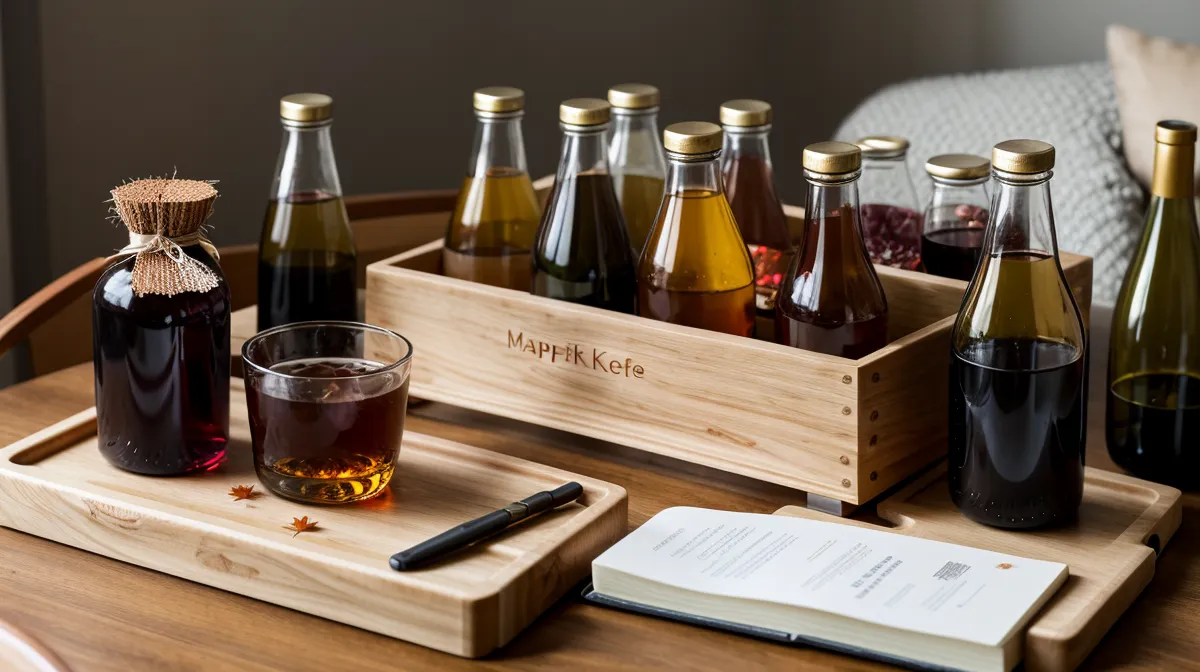
Knowing which rickhouse a bourbon came from is a completely different skill than knowing what to do when somebody hands you a glass of something from the Loire Valley, and for years I only had the first one figured out. My wife's book club kept leaving half-finished bottles on the kitchen counter after their Tuesday meetings, and I'd stand at the pass-through shelf — the one that held maybe three bottles back in 2018 and holds closer to fourteen now — trying to work out if what I was tasting was actually good or just wine-shaped. That's what sent me looking at beginner wine tasting kits in the first place: something structured enough to teach me the difference without turning my home bar into a bourbon-only operation.
Before I get into which kits actually stuck around, here's the practical part. Some of the retailers and non-alcoholic brands mentioned below pay me a small commission if you buy through my links, at no extra cost to you, and I bought every one of these myself because I was curious about the gap between bourbon and wine, not because a brand asked me to write this up. I'm a logistics project manager who happens to keep a shelf, not a doctor and not a sommelier, so none of this is medical guidance — talk to an actual doctor before you change your habits around drinking, and don't take my word for what's legal to have shipped where you live.
How a Beginner Wine Tasting Habit Started With a Calendar
My Tuesday group runs high-proof, and I didn't want to commit to a full case of something on a guess. Rather than find out the hard way whether a bottle earns a permanent spot on the shelf or gets quietly re-gifted to whoever visits next, I picked up a discovery calendar from In Good Taste Wines.
It's basically an advent calendar for adults — twenty-four bottles at 187 milliliters each, which works out to one generous glass, sourced from places like France, Chile, Argentina, Australia, and California, so you're covering more ground in one box than most wine-club shipments manage in a season. The tasting cards explain what you're actually smelling without the snobbery, which is how I landed on what a Tannin is in practical terms — not the textbook version, just the drying sensation on the back of my tongue that I already recognized from a well-aged bourbon, and it was enough to connect the two hobbies for the first time. Sorting bourbon from rye is still a separate education entirely, one I'm not getting into here, and there's a decanting argument that comes with wines this young that I'm staying out of too.
Is the Convenience Worth What You're Paying Per Glass?
The best part of the calendar is the range — one night you're in Chile, the next you're in California, and the choice paralysis I usually get standing at the wine wall just isn't a factor. What actually makes a kit worth keeping, though, is whether the bottles inside build on each other instead of just being twenty-four random pours in a box; a sequence that runs light to heavy teaches you something a grab-bag never will. The cost per glass runs closer to a steakhouse appetizer than a bottle-shop price tag, which sounds steep until you remember you're not pouring an entire bad bottle down the drain to find that out. It's made Comparing Bourbon and Red Wine Pairings for a Backyard Steak Dinner a lot easier, since I've actually got six or eight different reds on hand in small enough doses to run the test properly.
What Do You Pour When Someone's Cutting Back?
Fenton Burley's been part of the Tuesday rotation for a few years now, and about a year into the routine he started asking, without ever turning it into an announcement, whether I could keep something non-alcoholic around for him — hospital administration schedules that don't run on a normal week will do that to a person's habits. I started keeping Sober Carpenter stocked in the fridge for those nights. That wasn't the first thing I tried, either: an earlier non-alcoholic spirit I'd picked up smelled like the shelf at a hardware store, all pine and rubbing alcohol, nothing close to what it was supposed to stand in for.
Sober Carpenter is a different animal. The Blonde Ale has actual body to it, not the watered-down quality I braced for from anything labeled non-alcoholic, and it doesn't read like a consolation prize sitting next to everybody else's glass. Rotating a couple of their styles in and out turned out to be the real trick to keeping a non-drinking friend interested instead of just tolerating water for two hours, which is worth knowing if you're building a version of this fridge yourself. I lined a can up once against an allocated pour I'd gotten through Bourbon Concierge — the kind of bottle that takes knowing how to work allocation access rather than just knowing what you like — and Gareth, who logs every bottle either of us opens in a spreadsheet I've stopped trying to keep up with, noted the Sober Carpenter can right next to it without blinking. It held its own as a stand-in, which is honestly all a Tuesday regular cutting back is asking for. The mixed pack is worth grabbing first, if only to find out whether you're an IPA person or an Irish Red person before you commit to a full case of either.
When the Bottle Itself Is the Gift
Sometimes a bottle isn't about learning anything — it's about a coworker deserving something more specific than whatever's sitting on the endcap at the corner store. I'd been meaning to swing by Butchertown Market that Saturday anyway, and on the way I started looking into Mano's Wine for something custom-etched instead. They do officially licensed sports labels — NFL, MLB, the works — which matters more in a town that takes its teams as seriously as its mash bills.
The wine inside is perfectly drinkable and entirely beside the point — the label is the actual gift, which is worth knowing before you order one expecting a wine-club-caliber pour. I read the label under the pendant light over the island the way I'd read any bottle before a Tuesday pour, and it's a decent way to teach a beginner to connect a name on a label to whatever's actually in the glass, since even a custom bottle still lists a real varietal and region under someone's fantasy football logo. For the full rundown, Best Personalized Wine Bottles for Special Gifts and Milestones is the piece to read — just build in real lead time, because custom etching runs closer to four weeks than four days. When I'm on a shorter clock, I lean on Wine Country Gift Baskets instead, since they're one of the few in this category where the box actually shows up looking like the listing photo. A shipping rule tied to a dry county nearly derailed one of those orders last fall — direct-to-consumer alcohol rules shift state by state and sometimes county by county, and Kentucky has more of those lines running through it than people expect. You're paying for presentation there — the crate, the ribbon, a wedge of cheese that somehow survives the drive — which is a fair trade for a coworker gift and a bad one if what you actually wanted was a wine-club discovery.
Weighing the 2026 Lineup
Which kit makes sense comes down to what you're actually trying to accomplish on your own kitchen shelf, not which one wins some abstract ranking. Here's how I'd sort the field based on what's actually gone through a glass in my kitchen over the past few months, rather than what reads best on a product page.
Which One Actually Fits Your Situation?
If you want a rare bottle that feels like an occasion, Bourbon Concierge is the one working the phones for you instead of leaving you refreshing a website at midnight; just know you're paying anniversary-dinner money for that kind of access, not weeknight money. If you're trying to learn what you actually like without committing to a full case sight unseen, the In Good Taste calendar is still the one I hand people first, because low commitment beats a splurge when you don't know your own palate yet. If your Tuesday crowd has someone cutting back, Sober Carpenter earns fridge space without turning the night into a lecture about anybody's choices. And if the goal is a gift that photographs well and shows up on time, Wine Country Gift Baskets and Mano's Wine split that lane depending on whether you want speed or a name on the label.
The One Thing Worth Remembering
None of this makes me the neighborhood wine expert, and I'm not claiming otherwise. What it's done is make me the guy who remembers which bottle actually got finished versus which one quietly went home with somebody else. I'll still reach for Bourbon Concierge when I want something that feels like an occasion, but having a few wine kits under my belt means I'm not nodding blankly anymore when my wife's friends start talking about stone fruit.
By the fourth week of working through the calendar, one of the whites had stuck with my wife enough that she came home with a full bottle of it from the store on her own the next week, no prompting from me — that's about as clear a signal as a kitchen counter gives you that something's a keeper. If you're just getting into this, start with In Good Taste and spend a few weeks paying attention to what you actually reach for a second time. You don't need the technical vocabulary to notice that part.
If you're more interested in the grain than the grape, my notes on the Best Bourbon for Beginners to Sip Neat Without the Burn cover the mid-shelf end of that shelf, the bottles worth keeping in steady rotation rather than saving for an occasion. Either way, the only test I actually trust is whether a bottle makes you want to stay out on the porch twenty extra minutes. Everything else is just noise around that one, and that's the part worth carrying into the next bottle you open, whatever it is.