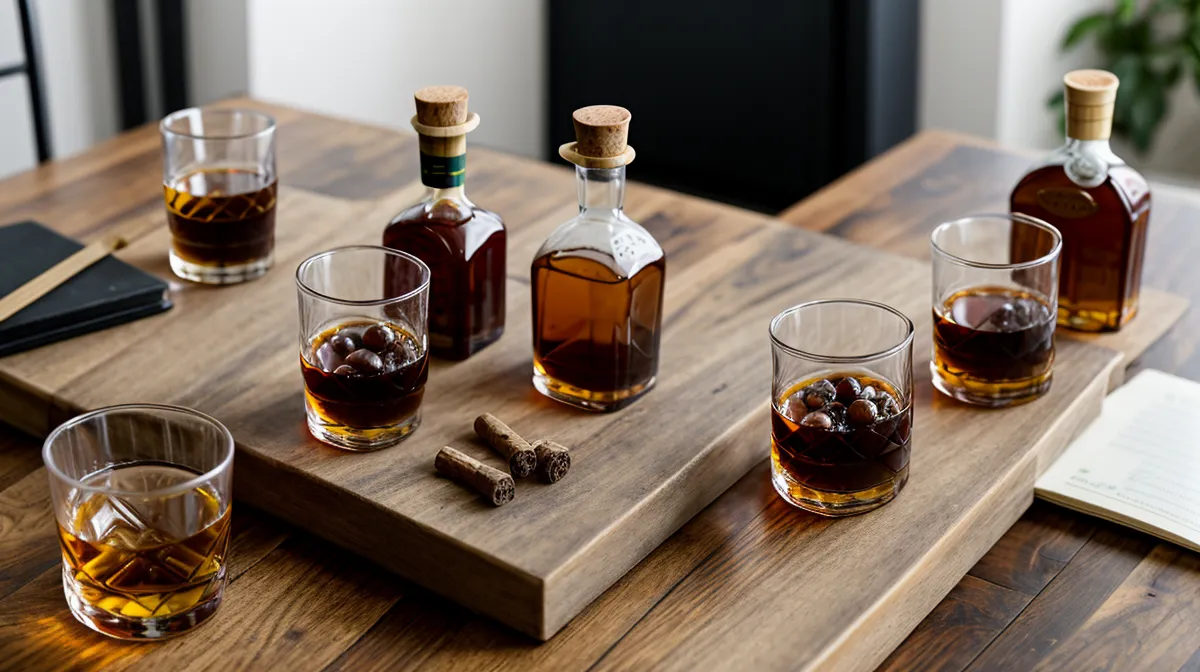
Late one Friday evening last September, I was leaning against the back porch railing with three of my neighbors, watching the humid Kentucky air settle over the yard. My kitchen pass-through shelf, which has slowly been colonizing more and more real estate since 2018, was visible through the window. One of the guys pointed at a dark amber bottle and asked if it was actually better than what he buys at the grocery store. It hit me then that my shelf had stopped being a personal hobby and turned into a neighborhood curiosity. I realized I didn’t need to be a distiller to walk them through it; I just needed to be a guy who knows which bottles actually get finished and which ones just collect dust.
Setting the Stage for a Saturday Pour
Moving from a casual chat to a structured Saturday afternoon tasting felt like a project I’d handle at the logistics office. I spent a good chunk of mid-January, during that particularly nasty cold snap that kept everyone indoors, sketching out how to do this without it feeling like a lecture. I’ve seen enough people get intimidated by the technical vocabulary of spirits. I don’t know what a “refined palate” is officially supposed to feel like, but I know when a drink reminds me of the charred oak barrels I see on trucks every day or when it tastes like a burnt marshmallow.
The goal was to make it as low-stakes as possible. I didn’t want anyone feeling like they had to perform expertise. I’ve had my own share of small embarrassments, like the time I tried to talk up a gift-basket Malbec a coworker gave me, only to realize it was about as complex as a juice box. It lasted exactly one Tuesday tasting before I admitted it was a miss. For this neighborly gathering, I wanted to avoid that pretense entirely. I planned for early April, right as porch season started to breathe again, aiming for a relaxed atmosphere where the bourbon was the guest of honor, but the conversation was the point.
The Plastic Cup Philosophy
Here is where I usually lose the enthusiasts: I skip the expensive glassware. I know there are people in Louisville who would treat using anything other than a crystal Glencairn as a personal insult, but for a casual neighborhood hang, I went with a sleeve of identical, inexpensive plastic tumblers. It’s about a steakhouse appetizer worth of investment, and it serves a specific purpose. When everyone is holding the same cheap cup, you aren’t judging the drink based on the weight of the glass or the prestige of a brand logo. You’re forced to judge the spirit based on the flavor alone. It levels the playing field.
It also removes the fear of someone knocking over a twenty-dollar glass on the patio. I’m not a health professional or a safety inspector, but I do know that keeping things unbreakable makes for a better night. If you’re worried about how much you’re consuming or how it interacts with your health, you should definitely talk to your own doctor before setting up a flight like this. My job was just to be the facilitator, making sure there was plenty of water and enough snacks to keep everyone on an even keel.
Building a Balanced Lineup
To keep things interesting, I selected four distinct profiles. I wanted to show the range of what counts as Bourbon whiskey without overwhelming anyone. I picked a high-rye option for spice, a wheated bourbon for that softer, sweeter profile, a classic Bottled-in-Bond, and a non-alcoholic alternative. Including a non-alcoholic option has become a staple in my rotation since one of my Tuesday tasting buddies decided to cut back. It ensures everyone stays included, and honestly, some of the newer analogs are surprisingly decent at mimicking that back-of-the-throat burn.
I’ve found that finding a non alcoholic beer that tastes like real beer after work is a great way to bridge the gap for neighbors who want the social aspect without the proof. For the bourbon selection, I stayed in the “tank of gas” price range—bottles that are high quality but won’t make you wince if someone accidentally pours a little too much. I’ve tried those best wine tasting kits for beginners before, and while they’re helpful, they often feel a bit too clinical. A backyard tasting should feel like a conversation, not a classroom.
The Technical Bits (That Actually Matter)
When the neighbors finally gathered in early April, the first thing I did was explain the ground rules—not to be a pedant, but because it actually helps you understand what you’re smelling. For instance, according to the federal standards, bourbon has to be at least 51% corn. That’s where that foundational sweetness comes from. If it’s labeled as Kentucky Straight Bourbon, it has to be aged for at least two years right here in the Commonwealth. These aren’t just trivia points; they’re the reason the stuff in your glass tastes different than a Scotch or a Canadian blend.
We stuck to a standard tasting pour size of 0.5 ounces. It sounds small, but when you’re trying four different spirits, it’s plenty to get the picture without losing your afternoon. I also made sure to mention the Bottled-in-Bond requirement. For a bottle to carry that label, it has to be exactly 100 proof, among other things. That higher alcohol content can be aggressive, so I showed them how adding just a few drops of room-temperature water can “open up” the glass. It breaks the surface tension and releases an ester or two, which is just a fancy way of saying it lets the floral and fruit smells escape the alcohol.
Porch Season and the Big Reveal
The turning point of the afternoon happened about halfway through. One of my neighbors, a guy who usually sticks strictly to light beer and doesn’t care for “fancy stuff,” was swirling his plastic cup of the wheated bourbon. He looked up, genuinely surprised, and said, “I actually get the vanilla. It’s not just alcohol burning my nose.” That “aha” moment is why I do this. Once the intimidation factor is gone, people start trusting their own senses. You don’t need to know the chemistry to know that you like the way the wheat rounds out the edges of the spirit.
Of course, not everything went perfectly. I had a moment of mild panic when I realized I’d forgotten to buy a fresh bag of ice for the water carafes. I was forced to use the cloudy, slightly-smelling-like-frozen-peas cubes from the back of my own freezer. It was a minor failure, but a good reminder that even a logistics manager can miss a detail. We laughed it off, and it probably made the whole thing feel even more casual. It reminded me of the time I was learning why you should decant wine before serving to your guests; sometimes the best lessons come from the small mistakes you make while trying to be a good host.
The Facilitator’s Aftermath
As the sun started to dip and the Ohio River fog began to feel like a distant memory compared to the warm spring evening, the glasses were empty, but nobody was rushing to leave. I realized that the best host isn’t the one who knows the most; it’s the one who facilitates the most fun. My neighbors left with a better idea of what they actually enjoy—one realized he loves the spice of a high-rye mash bill, while another decided he was going to stick to the softer wheated options. They remembered the labels because they had a hand in discovering them.
Long after the last neighbor headed home, I stood by the kitchen island, cleaning up the plastic tumblers. The faint smell of charred oak and vanilla was still lingering in the air, a pleasant ghost of the afternoon’s work. Hosting doesn’t have to be a performance. It can just be a few guys on a porch, some cheap cups, and a few bottles that tell a story. I’m no sommelier, but I know that a night where everyone learns something new and nobody feels out of place is a successful shipment in my book. Just remember to check the ice tray before the guests arrive—unless you really like the hint of frozen peas in your palate cleanser.